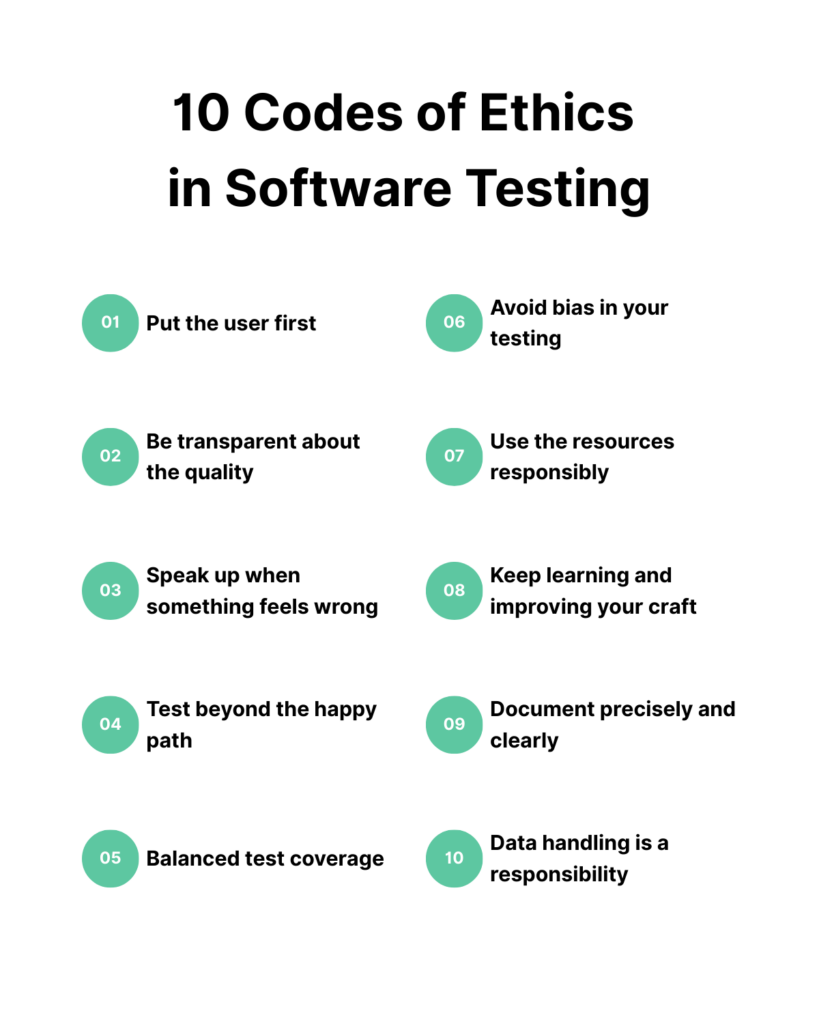
Code of Ethics turns testing from a routine task into a commitment to doing what is right for the product and the people who depend on it. When we follow ethics in software testing, it builds trust within the team as well as with the customers. Here are 10 codes of ethics in software testing based on my experience.
Put the user first
When doing testing, always think from the product user’s point of view. Their safety, privacy, and experience are more important than the release deadlines.
Whenever I test a feature, I try to step into the user’s shoes. Deadlines and pressure will always exist, but the users are the ones who live with the consequences of poor quality.
I ask myself:
- Is this safe for users?
- Could this confuse or frustrate them?
- Does it respect their privacy?
- What happens if something goes wrong?
Be Transparent About the Quality
Report the bugs that you see without any assumptions, and show the real state of quality, not what others want to hear. A tester’s integrity is one of the strongest defenses against releasing risky software.
That means:
- Reporting what I see, not what others want to hear
- Avoiding assumptions or sugar coating issues
- Clearly pointing out risks when they exist
Speak Up When Something Feels Wrong
If a bug puts users at risk or a release is being rushed without proper testing, it is your responsibility to raise the concern. Silence can cause more harm than a delayed release.
There have been many moments where a release felt rushed or a serious issue was being brushed aside. In those moments, staying quiet is not the right choice, and it leads to bigger problems later.
I believe it is my responsibility to:
- Raise concerns when users could be harmed
- Question releases that skip proper testing
- Make risks visible, even if the decision goes against me
Test Beyond The Happy Path
Real users face issues in real time scenarios. They make mistakes, use different devices, and operate under real-world constraints. Ethical testing is looking at edge cases, accessibility needs, and scenarios that might affect the vulnerable users.
Real users don’t always follow the perfect flows. So I take the below to test:
- Edge cases and error conditions
- Accessibility scenarios
- Interrupted workflows and slow networks
- Situations that might affect vulnerable users
Balanced Test Coverage
Our ethical duty is to ensure testing is thorough and fair. This means giving equal attention to all user types, focusing on high risk areas, and never skipping over parts of the product just because they are complicated. The balanced test coverage will provide confidence in the release.
I try to:
- Test all user types
- Focus more deeply on high risk areas
- Avoid skipping parts of the system since they are difficult to test
Avoid Bias in Your testing
Do not limit your tests to one type of device, browser, region, or user to overcome the discrimination bias.
But users and the environments are more diverse than our own test lab setups.
I actively remind myself to:
- Test across different devices and browsers
- Consider different regions and environments
- Think beyond my own usage patterns
Reducing bias in testing helps create more inclusive and reliable products.
Use The Resources Responsibly
Use company resources (time, test environments, and tools) efficiently and responsibly. Avoid unnecessary or repetitive testing efforts. Use only the tools and materials you are legally allowed to use. Treat all external code and data with care and follow the licensing rules.
That means:
- Avoiding unnecessary or repetitive tests
- Focusing effort where risk is highest
- Using only licensed tools and approved data
Responsible use of resources protects both the team and the organization.
Keep learning and Improving Your Craft
Technology changes quickly. Ethical testers stay curious, update their skills, and keep seeking better ways to protect quality. Continuous learning helps me to make better decisions for quality.
For me, that means:
- Learning new testing techniques
- Improving how I assess risk
- Adapting to changes in technology and user behavior
Document Precisely and Clearly
Good documentation helps others to understand risks and decisions. It is a sign of respect for the team and the product.
I have the habit of:
- Writing clear bug reports and test notes
- Document risks and decisions properly
- Leave enough context for others to understand my thinking
Data Handling is A Responsibility
Ensure any test data used, especially synthetic or production cloned data, is handled according to strict privacy regulations (like GDPR or HIPAA) and company policy. Once trust in the data is broken in the application, it is very hard to restore it.
I treat the data handling as a serious responsibility by:
- Following privacy laws like GDPR or HIPAA
- Respecting company policies
- Protecting sensitive information at every step
Closing Thoughts
Ethical Testing is the choices we make every day under pressure while doing the testing.
For me, it comes down to this:
- Put users first
- Be honest about quality
- Don’t ignore risk when you see it
That mindset has guided me throughout my testing career, and it is something I believe every tester should carry with them.
Happy Testing!
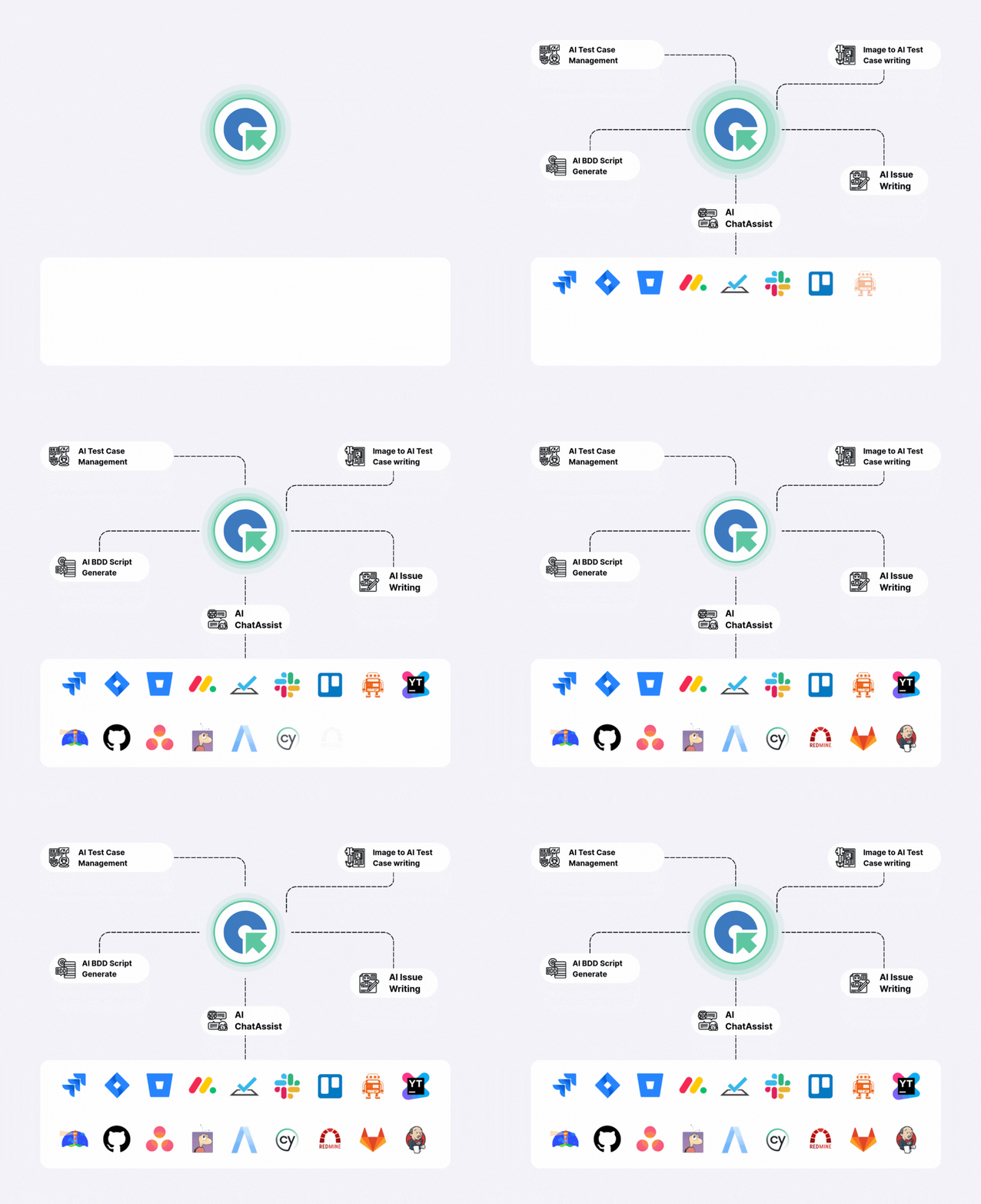
QA Touch is an effective AI Test Management Platform that stands out for its combination of test management and AI-driven test case generation, offering both power and simplicity in one platform.
Ready to bring AI into your QA workflow? Sign up for free today.