

Have you ever felt that sinking feeling when you look at a new feature’s configuration matrix and realize there are thousands of possible combinations to test? Your instinct tells you that testing only the “happy path” is risky, but testing every single permutation would take until next year.
Most test engineers spend their lives trapped between these two extremes. But what if I told you that you could find over 90% of your bugs by running only a tiny fraction of those tests? This is not “lazy testing”, it is Pairwise Testing, a mathematical shortcut that helps you test smarter, not harder.
What is Pairwise Testing?
Pairwise Testing (or All-Pairs Testing) is a combinatorial testing method based on the “Interaction Rule.”
Scientific studies (most notably by NIST) have shown that the vast majority of software bugs are triggered by either a single input parameter or the interaction between exactly two parameters. Bugs triggered by three or more variables interacting at once are statistically rare. Pairwise logic exploits this by ensuring that every possible pair of inputs is tested at least once, drastically slashing the total number of test cases without sacrificing significant quality.
Why Pairwise Testing?
Pairwise testing mirrors how real users behave. They use different browsers, roles, devices, and networks, often in combinations we do not expect. By intentionally covering these pairs, we reduce blind spots.
This approach also helps in easier defect reporting. Instead of saying “it fails sometimes”, you can clearly say “it fails when these two conditions are combined together”. When developers receive this kind of detail, it helps them save time in fixing issues.
- Breaking the Combinatorial Explosion: When variables increase, combinations grow exponentially ($3^{10}$ is nearly 60,000 tests!). Pairwise testing keeps the growth linear and manageable.
- High ROI: You can find the maximum bugs with minimum effort.
- Objective Selection: It removes the guesswork of which combinations to test, and provides a repeatable, logical framework.
When to Use Pairwise Testing?
We can use pairwise testing in the following scenarios. They are:
- Many parameters with multiple values
- Configuration/compatibility testing
- Exploratory Testing
- Full test coverage for critical safety systems
Pairwise Integration Testing
Pairwise testing is critical during integration testing, where multiple systems, modules, or third party services need to work together smoothly. At this stage, failures are rarely caused by a single component in isolation. When two components meet in a specific way, it leads to breaking the workflow.
Instead of validating that Service A works individually, pairwise testing focuses on how Service A interacts with other parts of the system. For example, you might test how Service A (version 1.1) behaves when connected to Database B (PostgreSQL) while running on OS C (Linux), and then repeat that with other valid combinations. The aim is to make sure every important pair of components is tested at least once.
This is important because most integration bugs are interaction bugs. A service may work perfectly until a downstream system sends a certain flag, returns data in a slightly different format, or responds more slowly than expected. These issues don’t show up in unit tests, and they are easy to miss if you rely on a small number of “happy path” integration tests.
In complex environments with microservices, multiple database engines, cloud platforms, feature flags, or external APIs, pairwise integration testing acts like an early warning system. It helps teams catch subtle incompatibilities early, before they turn into production incidents that are difficult and expensive to diagnose.
In simple words, pairwise testing is one of the most efficient ways to find issues fast and keep integration testing manageable.
Pairwise Testing: An Example
Let us consider you are testing a flight booking application with these options:
- Trip: One-Way, Round-Trip
- Class: Economy, Business, First
- Add-on: None, Extra Bag, Meal
An exhaustive approach requires 18 tests ($2 /times 3 /times 3$). Using Pairwise logic, we can cover every interaction in just 9 tests:
| Test | Trip | Class | Add-on |
| 1 | One-Way | Economy | None |
| 2 | One-Way | Business | Extra Bag |
| 3 | One-Way | First | Meal |
| 4 | Round-Trip | Economy | Extra Bag |
| 5 | Round-Trip | Business | Meal |
| 6 | Round-Trip | First | None |
| 7 | One-Way | Economy | Meal |
| 8 | Round-Trip | Business | None |
| 9 | Round-Trip | First | Extra Bag |
Note: Even though we cut the tests in half, every “Trip” type has been paired with every “Class” ,and every “Class” has been paired with every “Add-on.”
Benefits and Limitations
The benefits and limitations of pair testing as follows:
Benefits
- It reduces the number of test cases without losing meaningful coverage, helps teams test faster and at the same time validating the important interactions between input values.
The production bugs are caused by the interaction of two variables most of the time, and pairwise testing is very effective at bringing these issues early with less effort than exhaustive testing. - It works well for configuration and compatibility testing, as browsers, devices, operating systems, environments, and feature combinations.
- It saves time and cost while increasing confidence, allowing testers to focus their energy on analysis, exploration, and understanding the product instead of executing repetitive combinations.
- It can be combined with both manual and automated testing, and it is easy to adopt without changing existing tools or workflows.
Limitations
- It does not catch issues caused by complex combinations of three or more parameters, which can be critical in systems with business logic or safety requirements.
- The quality of results depends on how the parameters and values are defined, so missing or poorly chosen inputs will lead to a false sense of coverage.
- It can hide risk if used blindly, when teams rely on pairwise generation without considering the end user behavior or business impact.
- Constraints and invalid combinations must be handled carefully, otherwise tests may include scenarios that can never happen in real usage.
- It is not a replacement for exploratory, boundary, or risk based testing, and works best when combined with other testing techniques instead of using it alone.
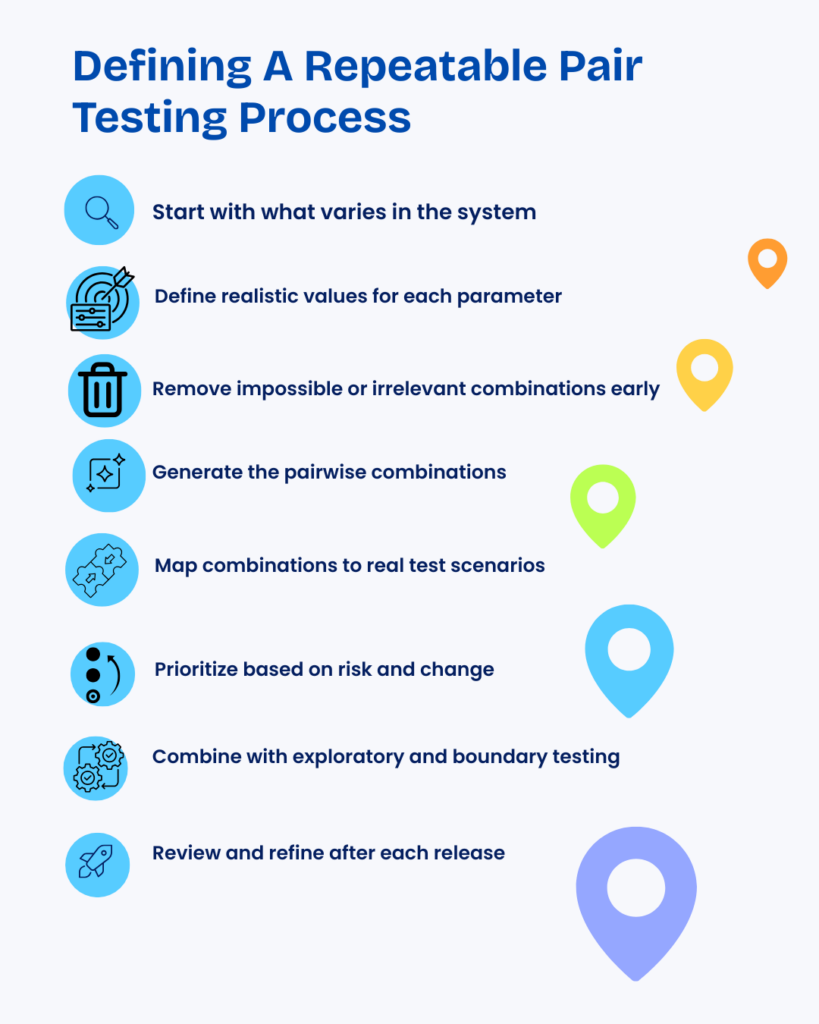
Defining a Repeatable Pair Testing Process
- Start with what varies in the system
When starting the pairwise testing, the first step is to understand what varies in the application and changes the user workflow. The conditions like browsers, devices, user roles, configurations, feature flags, environments, or key business rules. The mistake usually done is trying to list everything. Instead of it, focus on the variables that caused problems before, are frequently changed, or are likely to interact in the unexpected ways. If something rarely changes or has no impact on behavior, it probably does not need to be part of the pairwise model.
- Define realistic values for each parameter
Once the parameters are finalized, the next step is defining the realistic values for each one. These values should reflect how the product is actually used, not how it could be used in theory. For example, instead of listing all the browsers, include the browsers most of your users using. Similarly, covering every possible user role, focus on roles that behave differently or have specific permissions. This step is important than the tool, because with the best pairwise generator cannot compensate for poorly chosen values. If the inputs are not valid, the coverage will be misleading and wrong.
- Remove impossible or irrelevant combinations early
Before generating any test cases, spending time on removing combinations that cannot occur in real time use. Some scenarios might look valid but not applicable in real time. For example, combination of Windows OS and the Safari browser or a user role which don’t have any way to access that specific module. Defining these constraints in the beginning keeps the test set realistic and prevents wasting time on scenarios that add no value.
- Generate the pairwise combinations
With parameters, values, and constraints, you can generate the pairwise combinations using a tool like PICT, AllPairs, or a similar generator. The aim is not to reduce the number of tests but to make sure that every two way interaction is covered. Once the combinations are generated, it is important to do a quick review to check whether they are valid from a user and business point of view.
- Map combinations to real test scenarios
Each generated combination should be translated into a meaningful test scenario. Instead of treating the output as a technical data set, review what the user is trying to do, what data they are working with, and what is the outcome of that. This step helps to overcome the common pitfall where pairwise tests look great on the table but fail to mimic the real product and user behavior.
- Prioritize based on risk and change
Prioritizion of the test scenarios based on risk and recent changes is critical. Combinations that involve new features, complex logic, or critical business flows should be tested more frequently. Stable areas can be run less often or automated regression testing. This prioritization makes pairwise testing manageable and sustainable always.
- Combine with exploratory and boundary testing
Pairwise testing works great when combined with other testing approaches. It provides strong structured coverage, but it does not replace exploratory testing or boundary value analysis. The saved time can by utilzed to explore edge cases, and three or more factors interaction in complex ways.
- Review and refine after each release
Pairwise testing also need to evolve with the product life cycle. After defects are found in late testing or production, it is important to revisit the parameters and values and ask whether something was missed or underestimated. Updating the model based on real issues turns pairwise testing into a continuous learning process and it is not a onetime exercise, making it more effective with every release.
Checklist for Applying Pairwise Testing
Here is a checklist for applying pairwise testing.
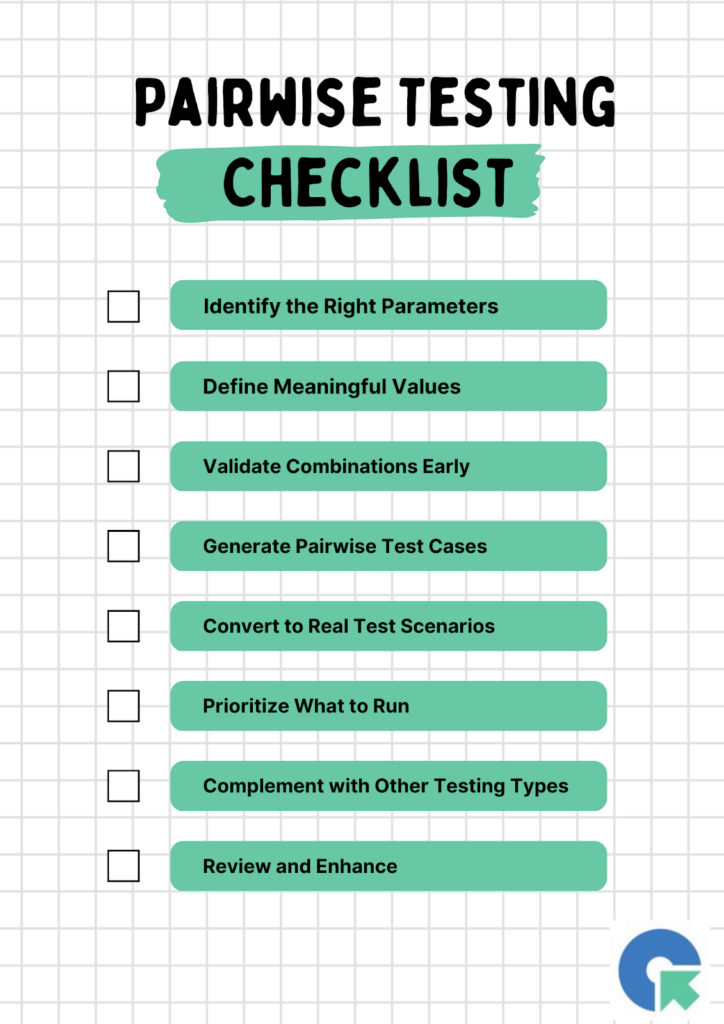
1. Identify the Right Parameters
☐ Have I listed only inputs that affect system behavior?
☐ Are these parameters based on recent changes, known risks, or past defects?
☐ Did I avoid adding nice to have or rarely used variables?
2. Define Meaningful Values
☐ Are the values realistic and based on real user data or production usage?
☐ Do the values represent differences in behavior, not just variations?
☐ Have I avoided unnecessary duplicates or overly granular values?
3. Validate Combinations Early
☐ Have I identified combinations that cannot occur in real usage?
☐ Are business rules, role restrictions, and environment limitations considered?
☐ Have I documented constraints before generating tests?
4. Generate Pairwise Test Cases
☐ Did I use a trusted pairwise tool (PICT, AllPairs, etc.)?
☐ Does the output cover every two way interaction at least once?
☐ Did I review the generated cases for sanity and relevance quickly?
5. Convert to Real Test Scenarios
☐ Can each combination be explained as a real user or system scenario?
☐ Are test steps clear enough for manual execution or automation?
☐ Do expected results focus on behavior, not just technical output?
6. Prioritize What to Run
☐ Have I tagged tests based on risk, criticality, or recent changes?
☐ Are high-risk combinations run more frequently than stable ones?
☐ Have I decided which tests are good candidates for automation?
7. Complement with Other Testing Types
☐ Have I planned exploratory testing around complex or unclear areas?
☐ Are boundary conditions and edge cases covered separately?
☐ Am I aware about pairwise does not cover 3 way or complex interactions?
8. Review and Enhance
☐ Were any production or late stage bugs missed by pairwise coverage?
☐ Do parameters or values need adjustment based on new learning?
☐ Is the pairwise model updated regularly, not treated as a onetime setup?
Reality Check
☐ Does this test set increase confidence, not just coverage numbers?
☐ Are we testing smarter, not just more?
Popular Open Source Pairwise Testing Tools
We are going to see a few popular open source pairwise testing tools in brief.
PICT (Pairwise Independent Combinatorial Tool)
- Repo: Microsoft open source.
- Type: Command-line tool (works on multiple platforms).
- Language: C/C++ but usable via CLI files.
It generates test cases based on input parameters and covers all pairwise combinations efficiently. It also has an option to add the constraints to skip invalid combinations. (For example – browser-OS pairs).
It reduces large parameter spaces into a smaller, high-impact set and ensures each pair of input options is tested.
AllPairs / python-allpairspy
- Library: Python implementation of a classic pairwise generator.
- Use: Embedded in test pipelines (e.g., with pytest).
It generates pairwise combinations from lists of parameter values and supports filtering out invalid pairs whenever needed.. It integrates easily into Python test automation and generates tests to cover pairwise combinations without the external tools.
ACTS (Automated Combinatorial Testing for Software)
Developed by the US National Institute of Standards and Technology (NIST), ACTS is a robust and versatile tool that supports pairwise, three way, and higher order combinatorial testing strategies. It is well suited for large, complex systems and allows users to define constraints to eliminate invalid combinations.
- Platform: Java-based, runs on various operating systems.
- Availability: Free and open-source.
Pro-Tip: The “Interaction Rule”
Why is Pairwise so effective? The National Institute of Standards and Technology (NIST) conducted an extensive study across multiple industries including medical devices, web browsers, and NASA database systems, to see exactly how many variables it takes to trigger a bug.
They discovered a pattern, and it is known as the Interaction Rule:
- 70% to 95% of all software bugs are triggered by just two variables interacting.
- 100% of the failures they studied were triggered by an interaction of six or fewer variables.
The Takeaway: You don’t need to test a million combinations to feel confident. By covering every 2-way interaction (Pairwise), you are mathematically likely to catch the vast majority of critical defects before they reach your users.
Final thought from experience
Good testing does not involve executing a large set of test combinations. It should be focused on smart coverage. Pairwise testing helps you find real issues faster, explain them better, and use your time wisely. Once you start using it, you will notice fewer random tests and more meaningful results. Pairwise testing is a powerful optimization technique, and when combined with exploratory testing, risk based testing, and domain knowledge, it delivers strong coverage with far less effort.
Further Learning Resources
- NIST (National Institute of Standards and Technology)
This is the “Gold Standard” resource. NIST is a U.S. government agency that has conducted the most extensive research into why pairwise testing works.
- Key Resource: Practical Combinatorial Testing (SP 800-142). This is an 81-page free PDF that serves as a self-contained tutorial. It covers the math, the tools, and the empirical data.
- Pairwise.org
This site is one of the earliest and most focused on all pairs testing. It explains the basic ideas, benefits, and some tools in a straightforward way. Great for understanding the why behind pairwise testing. - Cem Kaner’s Writings on Combinatorial Testing
Cem Kaner is a respected voice in software testing, and his articles on combinatorial and pairwise testing are practical and grounded with expert testing experience. These articles help you see how pairwise fits in with overall testing strategy. - Satisfice / James Bach Articles
Satisfice (James Bach) has essays and notes on combinatorial and risk-based testing approaches. They are not heavy academic papers they are written by seasoned test leader sharing what works.
Happy Testing!
QA Touch is an effective AI Test Management Platform that stands out for its combination of test management and AI-driven test case generation, offering both power and simplicity in one platform.
Ready to bring AI into your QA workflow? Sign up for free today.